London Development Finance 2026: £650/sqft Viability Cliff
If you took just one number out of London property development in 2026, it would be £650 per square foot. That is the threshold Molior’s analysis identifies as the binary line between viable and undeliverable for residential schemes across Greater London. Below it, the maths does not work on current build cost, finance pricing and end-value economics. Above it, schemes are being underwritten and built.
The most striking implication: of the 281,000 unbuilt consented homes across the 33 London boroughs, only 119,200 sit above the threshold. The other 162,000 are effectively undeliverable on current economics. That is more than half of London’s planned housing stock sitting on consents that will not translate into deliveries unless either values rise or build costs fall meaningfully.
Watch the full data-led breakdown: The £650/sq ft Cliff on YouTube.
How the threshold became a hard filter
The £650 number is not a planning artefact. It is a build-cost-versus-GDV equation applied at the senior debt underwriting stage. Lenders are not negotiating it. They are applying it as a yes/no filter on the GDV input of every appraisal that comes through the door.
The reason it became binary in late 2025 is the combined effect of three pressures: build costs that climbed roughly 22% between Q1 2022 and Q4 2025; senior debt margins that widened sharply post the 2022 mini-budget and only partially reversed after the December 2025 Bank of England cut to 3.75%; and end values that have been flat-to-down across most of Greater London over the same window. Each pressure on its own would have been manageable. Together they pushed the marginal scheme below the financeability line.
Where the line falls borough by borough
The threshold splits London cleanly. Most of the prime central postcodes still clear it on price even after recent corrections, but with rising build costs eating much of the headroom — Westminster is down 10.8% year on year and Kensington and Chelsea down 11.2%, but average values in those boroughs still sit comfortably above £1,200/sqft.
In the connected outer ring, the threshold is the active question. Walthamstow, Redbridge and Croydon clear it on transport-adjacent sites. Bromley clears it in town-centre regeneration. Further out, in parts of Bexley, Havering, Hillingdon and Sutton, only specific micro-locations near rail nodes clear it — and many sites do not.
For the major regeneration platforms, the threshold has been priced in from the masterplan stage. Old Oak/Park Royal, Royal Docks, Earls Court (Hammersmith/Fulham), Meridian Water in Enfield, Canada Water in Bermondsey/Southwark, and Brent Cross Cricklewood in Barnet all sit above it on the proposed product mix.
What the threshold means for capital structures
The pricing table above shows the practical effect. Below the line, schemes are not financeable through conventional senior debt — they need either a change-of-use angle that lifts GDV, a meaningful equity component to absorb the gap, or a public-sector partner taking specific risk off the table. Several outer-borough schemes are quietly being repositioned as PBSA or BTR specifically because the institutional take-out values clear the threshold where open-market resi values do not.
At the line, schemes are financeable but tightly. Senior development finance prices around 6.5% to 7% per annum at 65% LTGDV. Mezzanine layers in to take leverage to 90% of cost at 12% per annum. The all-in blended cost lands in the 7.5% to 8.5% range, which is workable but demands cost certainty.
Above the line, pricing tightens by 25 to 50 basis points across each layer, and forward-funding take-outs from BTR or PBSA institutional buyers re-enter the conversation. That is the structural advantage of schemes that clear the threshold by 100 to 200 pounds — they get the pricing benefit on the way in and the take-out optionality on the way out.
What changes the threshold
Three forces could move the £650 number meaningfully through 2026 and into 2027.
The first is rates. The December 2025 Bank Rate cut to 3.75% has already partially flowed through senior margins. Further cuts of 50 to 75 basis points would lift the financeable share of the consented pipeline by an estimated 18,000 to 25,000 homes — those schemes currently sitting just below the line.
The second is build costs. UK construction tender price inflation moderated through 2025 but remains positive. A flat or declining tender price index through 2026 would compound the rate effect.
The third is the policy package. The Time-Limited Planning Route at 20% affordable housing by habitable room, combined with the Mayor’s emergency measures and the second NPPF consultation outcome, materially improves the GDV input on a meaningful slice of consents. For the right scheme in the right borough, the policy uplift alone is worth £30 to £80 per square foot.
What this means for site acquisition
If you are pricing a London site in 2026, the threshold question is the threshold question. Run the appraisal at £650 per square foot first. If it does not clear at credible build cost, the site is not financeable through conventional channels regardless of how attractive the land basis looks.
Where appraisals clear the threshold, the next questions are the obvious ones: planning runway, infrastructure cost allocation, capital structure fit. But the threshold filter removes most of the bad questions before they reach lender decks.
For full borough-by-borough sold price data, viability scenario modelling, and the underlying capital stack benchmarks behind this analysis, see the Greater London Property Market Report 2026.
See also: Walthamstow +5.9% — the lead outperforming borough on YouTube, where transport-adjacent sites still clear the £650 line.
Listen to the full episode
For the dedicated deep dive on the £650 viability cliff, we have just published a stand-alone episode of the Construction Capital podcast: The £650 Cliff: London’s Single Most Important Number in 2026. Eight minutes covering how the threshold became a hard lender filter, where the line falls borough by borough, and the three forces that could move it through 2026. The full episode transcript is also available.
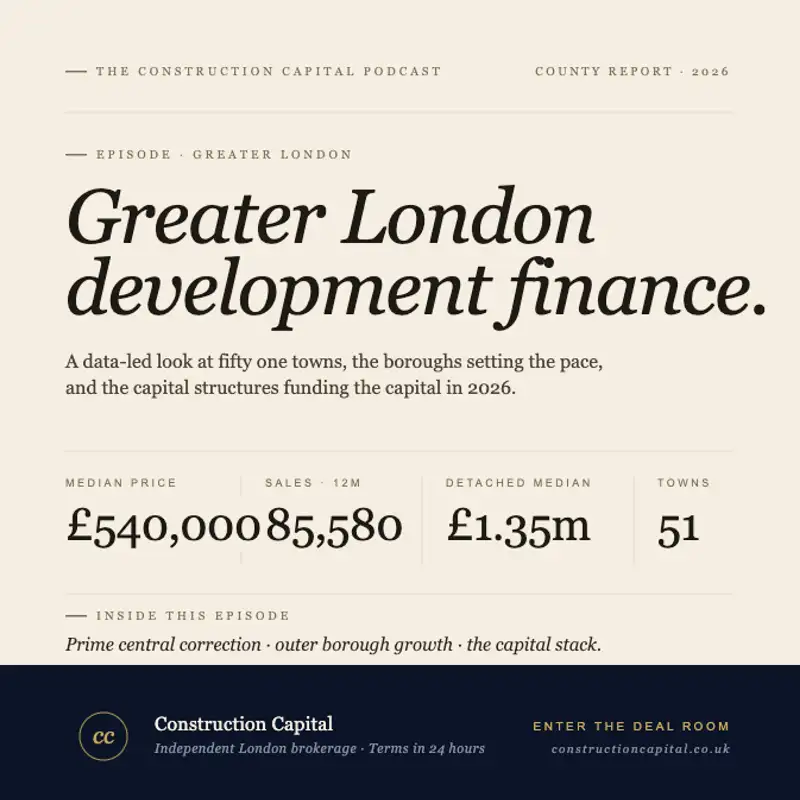
This piece also draws on Episode 2 of the Construction Capital podcast: Greater London Property Development Finance 2026: Market Analysis, House Prices and Lending Outlook. The wider Greater London 2026 context — including the Walthamstow +5.9% deep dive, the Elizabeth Line corridor effect, regen platforms and the full London capital stack — sits across that series.
Listen anywhere
Listen on Apple Podcasts, Spotify, Overcast, Pocket Casts, or Amazon Music. Or subscribe to the show for new episodes as they land.
For indicative terms on a London scheme within 24 hours, submit through the Construction Capital deal room.
Published by Construction Capital, an independent capital advisory brokerage sourcing terms from over 100 lenders across development finance, bridging, mezzanine, and equity. This article is part of a 20-piece Greater London 2026 series accompanying the Construction Capital podcast.